Semantic Education: The Neuroscience of Combined Knowledge
The Biology of Education Series
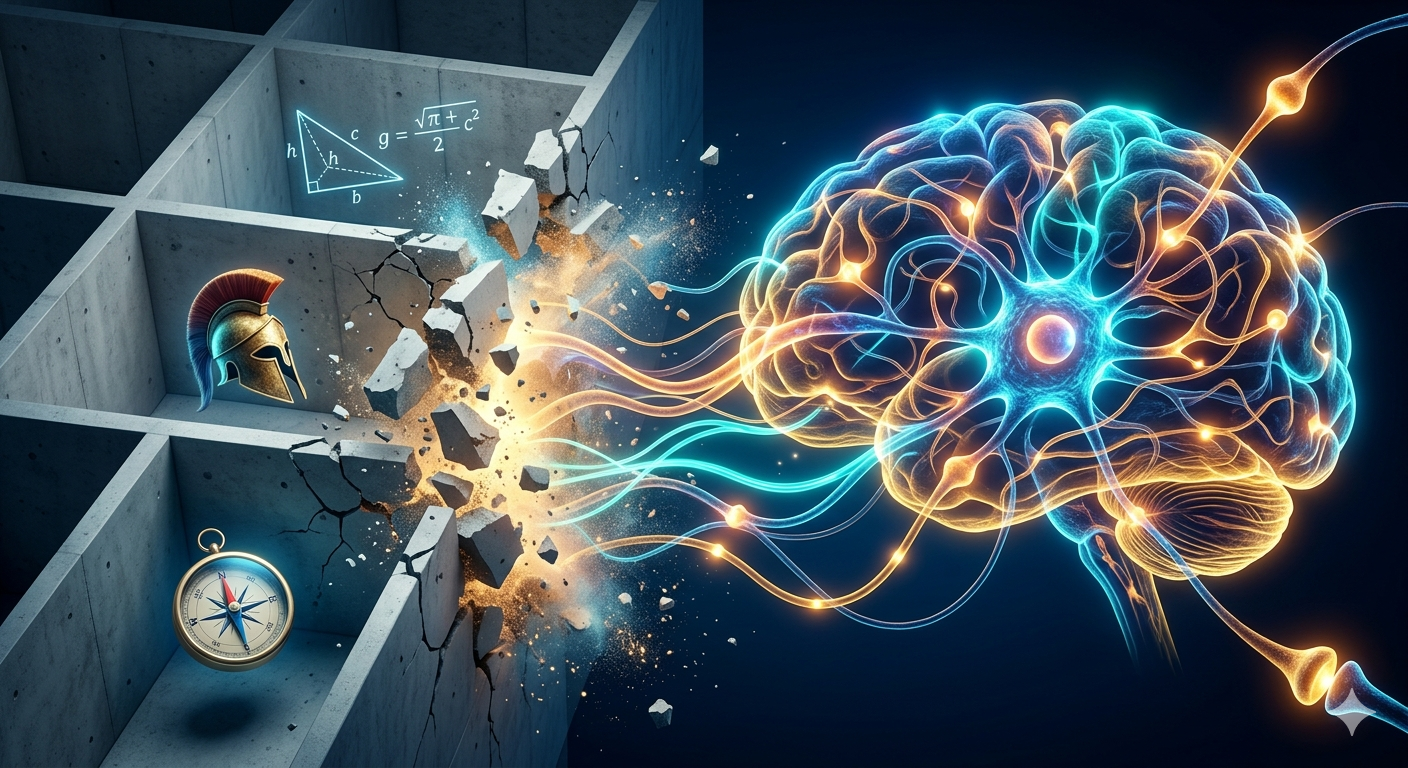
Traditional schooling separates knowledge into rigid, isolated silos - math at 9:00 AM, history at 10:00 AM. Semantic Education breaks down these artificial walls, deliberately interweaving disciplines like geography, history, and physics into a cohesive network. When we learn facts in isolation, they are stored as fragile, easily forgotten data points.
However, when we intentionally connect new concepts to an existing web of knowledge, we tap directly into the mechanics of neuroplasticity. Neurobiological research shows that our semantic memory system relies on distributed neural networks; when multiple related concepts are activated simultaneously, the brain strengthens the synaptic connections between them.
The Schema Effect
System neuroscience indicates that prior knowledge acts as a "schema" - a mental framework that dramatically accelerates memory consolidation, transferring information into long-term storage far more efficiently than rote memorization.
Instead of building a single, narrow pathway to a memory, this interconnected approach builds a massive, multi-lane highway system of associations. If you forget one specific fact, your brain can easily navigate an alternate route via an interconnected subject to retrieve it, profoundly increasing long-term recall.
From Theory to Practice: Interlinking Subjects
Transitioning to semantic learning doesn't require a massive leap; you can start simply by exploring connections in pairs. Consider the geography of history: instead of memorizing the date of a battle, look at how deep mountain passes, fertile river valleys, or harsh winter climates dictated the rise, strategic military movements, and ultimate fall of human civilizations.
Similarly, consider the history of physics. A breakthrough like Newtonian mechanics shouldn't be memorized as an isolated set of mathematical formulas. Instead, look at the cultural context of Europe in the late 17th century - how the intellectual landscape of the Scientific Revolution and the expanding maritime trade routes demanded highly precise navigation, which directly fueled the need to calculate planetary motion and tidal forces.
Reduced Cognitive Load
When students understand the contextual gravity of a subject, cognitive load is reduced because the new information naturally anchors itself onto schemas they already understand. Integrating knowledge from disparate fields also drives cognitive flexibility and team problem-solving dynamics, preparing the mind for high-level analytical environments.
A study at the Karolinska Institute showed how powerful this is. People were asked to invent new things by combining objects. When they worked with objects they already understood, they were far better at it. When they were given meaningless symbols they knew nothing about, they did no better than random guessing. The knowledge they already had was doing the heavy lifting, not the effort itself. This is why building on what a learner already knows can speed up learning by up to five times, and lock the new information in far more securely for the future.
The Biological Engine of Personalization
Semantic learning reaches its peak performance when it thrives on personalization, leveraging a learner's unique, pre-existing interests as a powerful biological accelerator for engagement. Imagine a student struggling with abstract algebraic equations. By mapping those exact mathematical variables directly onto fields they love - such as tracking the trajectory and spin mechanics of a basketball, or calculating the precise ingredient ratios and temperature scaling required in culinary arts - the material transforms instantly from an alien chore into a highly relevant tool.
Neuroscientifically, utilizing a person's intrinsic interests triggers a surge of neurotransmitters like dopamine. Intrinsically regulated learning success - even in the absence of external rewards - directly activates the dopaminergic midbrain, hippocampus, and ventral striatum loop. This dopaminergic activity is central to the brain's internal "SEEKING" and reward systems, which are heavily tied to cognitive flexibility, exploration, and behavioral persistence.
These chemicals act as the brain's internal "save button," drastically increasing attention, enhancing focus, and accelerating memory consolidation. Because the material is anchored to an existing passion, learning becomes profoundly faster - and the knowledge becomes a permanent part of the student's cognitive framework.
Conclusion: Engineering an Adaptable Mind
This also changes how we should think about what one generation passes to the next. The most valuable thing we inherit is not a library of facts or a list of past inventions, but a living toolbox - an understanding of how the world fits together. Facts can be looked up in seconds. The ability to see how things connect is the real inheritance, and it is exactly what an interconnected approach to learning builds.
Ultimately, semantic learning completely redefines the pursuit of knowledge, turning education into an active journey of discovery rather than a passive chore of rote memorization. By deliberately interweaving disciplines, you are no longer just collecting disjointed facts to pass an exam; you are structurally building a more adaptable, resilient, and deeply curious mind.
This approach leaves you with an integrated understanding of the world, priming your brain to notice hidden patterns, synthesize complex variables, and make innovative connections that others might overlook - forever altering how you perceive the interconnected nature of reality.
References
Chrysikou, E. G., et al. (2024). Creative connections: the neural correlates of semantic relatedness are associated with creative performance. Scientific Reports, 14, 15516.
Di Domenico, S. I., & Ryan, R. M. (2017). The Emerging Neuroscience of Intrinsic Motivation: A New Frontier in Self-Determination Research. Frontiers in Human Neuroscience, 11, 145.
Kuperberg, G. R., & Stoddard, E. M. (2022). Functional connectivity of brain networks during semantic processing in older adults. Frontiers in Aging Neuroscience.
Lindström, B., et al. (2024). Semantic knowledge as a precondition for human innovation. Karolinska Institutet / Vrije Universiteit Amsterdam.
Ripollés, P., et al. (2018). Intrinsically regulated learning is modulated by synaptic dopamine signaling. eLife, 7.
van Kesteren, M. T. R., Ruiter, D. J., Fernández, G., & Henson, R. N. (2012). How schema and novelty augment memory formation. Trends in Neurosciences, 35(4).
Webb, C. E., & Dennis, N. A. (2019). Memory for the usual: the influence of schemas on memory for non-schematic information in younger and older adults. Cognitive Neuropsychology, 37(1-2), 58-74.
Want to explore Semantic Education for your learners?
Reach out to discuss how EZ42's Echo and Omega bring interconnected, personalized learning to life.
[email protected]