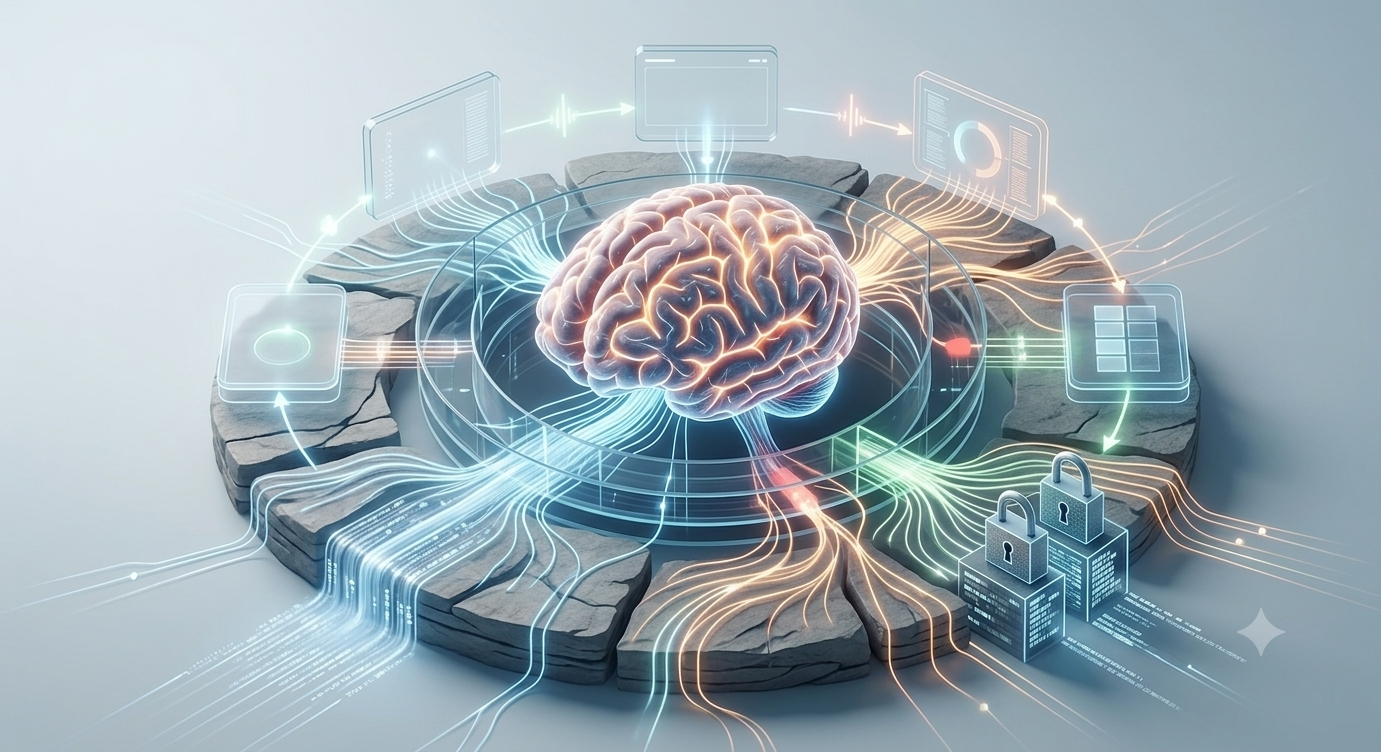
Active Predictive Inference (API)
The Architecture of Autonomous Neural Encoding
For decades, modern education has treated the multiple-choice question (MCQ) as a tool of post-mortem assessment, a backward-looking metric designed to measure what a mind has already retained. This approach misses one of the most powerful levers in cognitive neuroscience. When engineered with precision, a question is not a thermometer used to read temperature; it is a thermostat used to change it.
By utilizing a proprietary, algorithmically calibrated matrix of choices and immediate feedback loops, we can shift the brain from a passive recipient of information to an active generator of knowledge. This framework is called Active Predictive Inference (API).
API synthesizes disparate breakthrough principles in cognitive psychology, neurobiology, and error-driven learning into a deterministic, closed-loop educational technology. It transforms the question into an automated engine of rapid, autonomous, and permanent neural encoding.
The Core Philosophy: The Brain as a Prediction Engine
The foundational premise of API is rooted in predictive processing. The human brain does not sit back and wait for sensory data to wash over it; it is a highly active, forward-looking prediction engine. It constantly generates internal models (theories) about how the world works, projecting them forward to anticipate what comes next.
When a learner encounters standard textbook paragraphs or videos, the brain remains largely passive. It nods along, experiencing a dangerous illusion of competence while doing minimal neurological heavy lifting.
API disrupts this passivity. By presenting a mathematically balanced cognitive challenge before formal instruction, it forces the learner's mind into a state of active generation. The learner cannot merely read; they must immediately build a localized theory to navigate the specific environment presented to them.
The Proprietary Cognitive Matrix
To trigger Active Predictive Inference deterministically, content cannot simply be written; it must be mapped into a specialized Inference Scaffold.
This scaffold does not present traditional "test questions." Instead, it acts as a harnessed, proprietary semantic container. By processing raw knowledge through a closed-loop logical framework, our engine creates a precise field of cognitive tension.
Raw Knowledge → Proprietary Syntactic Engine → Harnessed API Tension Field
The underlying syntax used to generate these environments is closely guarded, designed specifically to prevent passive elimination or simple guessing. Instead, the architecture acts as a precise mental mold. The learner's mind is forced to pour its own reasoning into this container, executing an internal simulation that aligns perfectly with the target knowledge structure.
The Learner's Journey: The Three Phases of API
While the underlying generation mechanics remain proprietary, the cognitive journey experienced by the learner is entirely observable and scientifically verified.
- Active Induction. The process begins by inducing an acute state of focus. The environment is engineered to isolate the exact logical inflection point of a concept. This creates an immediate need for deep semantic differentiation, instantly capturing the learner's full processing capacity.
- Predictive Inference. Faced with highly disciplined choices, the learner's mind is forced to form a predictive hypothesis. To progress, they must mentally simulate the logic of the system. By committing to a choice, the learner explicitly anchors their internal model to a specific prediction. Neurologically, this act of commitment unlocks the network, rendering the neural pathways associated with that concept temporary, unstable, and highly receptive to modification: a state known as lability.
- Neural Consolidation. The moment the user locks in their choice, immediate targeted feedback is delivered. The magic happens in the instantaneous comparison between the learner's internal theory and reality.
If their theory was flawed, the brain experiences a stark prediction error. This unexpected gap causes a massive spike in attention (neurologically driven by dopamine signals and P300 brain wave activity). The brain recognizes the error, downweights the faulty neural associations, and instantly overwrites them by strengthening the correct pathway. If they were correct, the feedback acts as a resonance mechanism, locking the tentative hypothesis into a permanent structure.
The Scientific Substructure of API
API does not invent new biology; it synthesizes existing, rigorously validated scientific phenomena into an intentional learning technology.
- Desirable Difficulties: Cognitive science proves that making a learning task intentionally effortful enhances long-term retention. By forcing structural reasoning before providing answers, API introduces a highly productive strain that primes the brain for deep processing (Roediger & Butler, 2011).
- Memory Reconsolidation: Traditional theory held that old memories are permanent and unchangeable. Neuroscience now proves that retrieving a memory or activating a mental schema brings it into a fragile, "labile" state where it can be edited. API intentionally activates these existing schemas, making them pliable, and then uses immediate feedback to insert the updated, correct data directly into the network (Ye et al., 2020).
- The Hypercorrection Effect: Entrenched errors are notoriously hard to fix via passive reading. However, research demonstrates that when a learner makes an error after deep reasoning and receives immediate correction, retention of the correct information is exceptionally high. The surprise of the error forces the brain to pay hyper-attention, causing it to deeply encode the correct feedback (Fazio & Marsh, 2009; Metcalfe & Finn, 2011).
A Deterministic Shift in Learning
What makes Active Predictive Inference genuinely novel is its determinism. Instead of relying on a learner's fluctuating motivation or passive attention spans, API relies on foundational neurobiological reflexes. If the cognitive environment is structured correctly by the engine, the brain must infer; if the brain infers, it must predict; and when the prediction meets immediate feedback, the network must update.
By treating the learner as an active scientist testing hypotheses rather than a bucket to be filled with facts, API shifts the heavy lifting of instruction onto the automated architecture of the platform. It removes the need for dense, exhausting instructional overhead and replaces it with a rapid, highly engaging pulse of active thought.
By leveraging the brain's natural evolutionary mechanics of error-driven learning, Active Predictive Inference enables us to teach and strongly encode lasting knowledge and skills, autonomously and many times faster, while managing healthy cognitive loads.
References
Fazio, L. K., & Marsh, E. J. (2009). Surprising feedback improves later memory. Psychonomic Bulletin & Review, 16(1), 88–92. https://doi.org/10.3758/pbr.16.1.88
Metcalfe, J., & Finn, B. (2011). People's hypercorrection of high-confidence errors: Did they know it all along? Journal of Experimental Psychology: Learning, Memory, and Cognition, 37(2), 437–448. https://doi.org/10.1037/a0021962
Roediger, H. L., & Butler, A. C. (2011). The critical role of retrieval practice in long-term retention. Trends in Cognitive Sciences, 15(1), 20–27. https://doi.org/10.1016/j.tics.2010.09.003
Ye, Z., Shi, L., Li, A., Chen, C., & Xue, G. (2020). Retrieval practice facilitates memory updating by enhancing and differentiating medial prefrontal cortex representations. eLife, 9. https://doi.org/10.7554/elife.57023
Let's keep the conversation going 💬
I'd love to hear your take on this, whether you see things differently or if this aligns with your own experience. If you're reflecting on what to do now with these ideas or wondering how they might look in your specific situation, let's talk about it.
I'm always happy to trade thoughts or brainstorm how this applies to your world.
✉️ Drop me a note: [email protected]