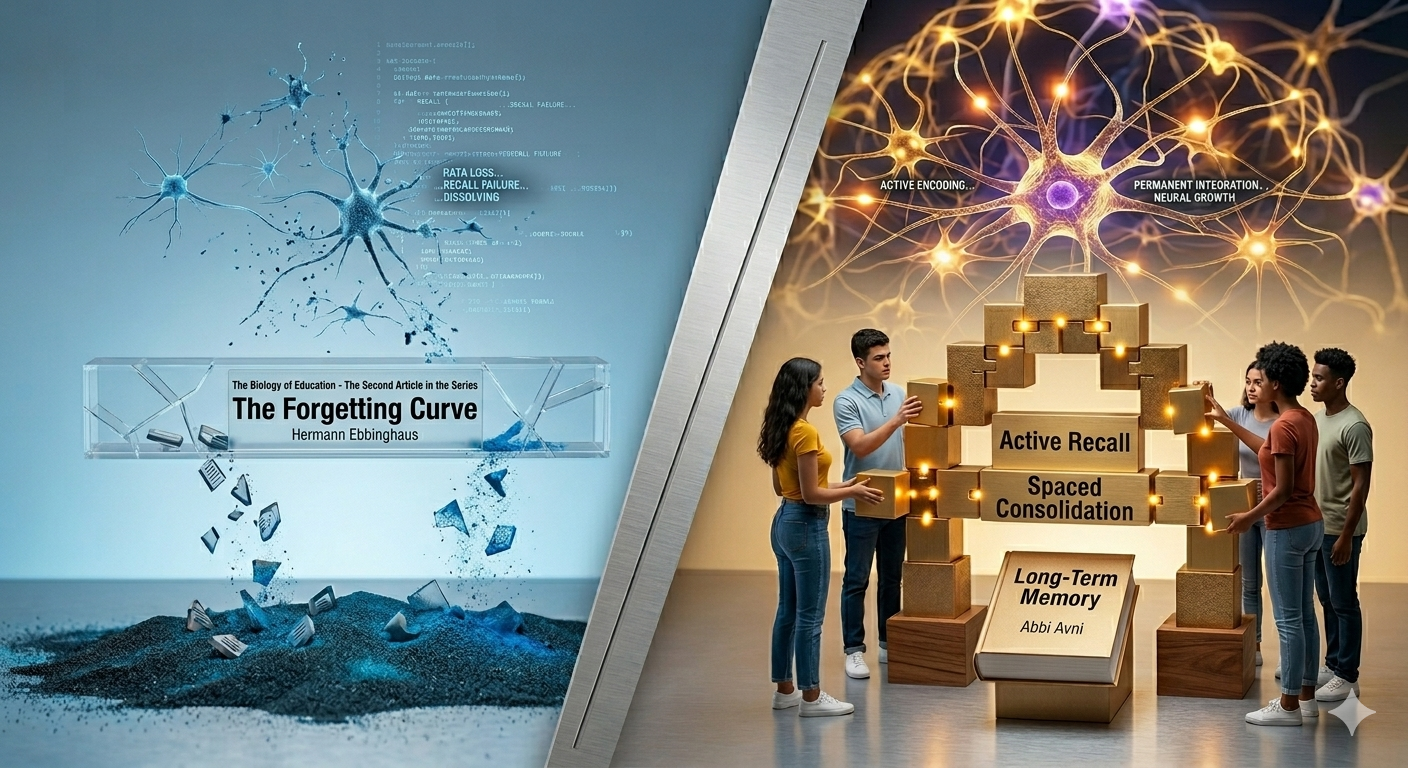
The Biology of Lasting Memory
Why the Brain Erases What We Learned - and How to Prevent It
Second article in the "Biology of Education" series
By: Avi Avni
Every school principal and every educator knows the moment. A whole class "mastered the material" for the test. The scores were good. Everyone felt the goal had been reached. And two weeks later, when the same topic comes up again, an uncomfortable truth surfaces: most of what was learned is simply gone.
This is not a local glitch, and it is not the fault of a lazy student or a weak teacher. It is a built-in feature of the human brain. More than a century ago, Hermann Ebbinghaus described the "forgetting curve" - the rapid pace at which new information erodes the moment we stop using it. In our education systems, we pour nearly all our resources into the acquisition of knowledge, and almost none into its retention. We measure what the student knows on Tuesday, and ignore the real question: what will be remembered a month from now?
The first article in this series dismantled a myth ("learning styles") and pointed to two techniques the science actually supports. This article takes the next step and builds the full picture: what are the biological mechanisms that decide whether knowledge stays or gets erased, and why a system that understands them can accelerate learning instead of fighting it.
Mastery Is Not Memory
The most expensive mistake we make is assuming that if a student performed a task successfully - they have also learned it. But successful performance in the here-and-now leans heavily on temporary memory: information "floating" in working memory. It is a fragile state. The moment attention shifts to the next topic, that information starts to fade.
The reason is that the brain is not a hard drive. It does not "save a file" when we learn something. Real learning is a physical process in which the brain reshapes itself - building and strengthening connections between neurons. And that process demands time, repetition, and processing. Without them, the new connection stays loose and falls apart.
This is the source of the problem with the most common method of review: rereading the material. Rereading feels like learning - the material is familiar, it "flows," the student is convinced they know it. But that familiarity is an illusion. It measures how easily we recognize information, not our ability to retrieve it when we need it. And on test day - or, more importantly, in real life - what is needed is retrieval, not recognition.
Three scientific principles, working together, determine whether knowledge gets locked in for the long term. We will look at each at the level of principle - and especially at the why behind it.
Principle One: Active Recall
The difference between reviewing material and retrieving it from memory is the difference between reading and effort. When we force the brain to generate the answer on its own - rather than merely recognize it on the page - we physically alter the memory's imprint and strengthen it.
This is what research calls the Testing Effect. Roediger and Karpicke (2006) showed that the act of retrieval itself - not passive review - is what makes memory resistant to forgetting. Put simply: every time you manage to retrieve information through effort, you are not only "checking" that you know it - you are also teaching the brain to hold onto it better next time.
The subtle point: it is precisely the difficulty that delivers the advantage. Bjork and Bjork (2011) coined the term "Desirable Difficulties" - when retrieval demands real effort, its neurological payoff is greater. Learning that feels too easy rarely leaves a mark; learning that requires exertion stays. This is one reason a common educational instinct ("let's make it easier for the student") can work against the very goal it intends to serve.
Principle Two: Metacognitive Reflection
Retrieval alone strengthens memory. But for knowledge to become deep, flexible, and transferable, another layer is needed: meaning-making.
This is where metacognitive reflection enters - the moment the student not only retrieves an answer but explains to themselves why it is correct, and how it connects to what they already know. Chi and colleagues (1989) showed that students who explain the material to themselves while learning (Self-Explanation) integrate it more deeply into their existing cognitive structures - and therefore understand it better and apply it more broadly.
For social-emotional (SEL) and behavioral skills, this layer is especially critical. Immordino-Yang and Damasio (2007) demonstrated that reflective processes activate brain networks responsible for empathy, self-regulation, and decision-making. In other words: without reflection, a behavioral skill remains theoretical knowledge. With reflection, it begins to become part of how the person thinks and acts.
The thread connecting the first two principles: Active Recall determines that the information stays; Reflection determines that it is usable.
Principle Three: Spaced Consolidation
The third principle deals with time. The brain cannot perform the reorganization of memory - the transition from temporary storage to a stable, permanent network - in a single event. That process, called consolidation, requires intervals, and it requires sleep.
The Spacing Effect is one of the strongest and most consistent findings in the learning sciences. Cepeda and colleagues (2008) showed that learning spread across intervals produces long-term memory that is far superior to learning crammed into "one shot" - the familiar "all-nighter before the exam." The same amount of study time, properly distributed, produces memory that is multiple times more durable.
Why? Because each interval forces the brain to retrieve information that has started to fade - and it is precisely that moment, of retrieval on the edge of forgetting, that stabilizes the neural connection for the long term. Time is not the "enemy" of learning. Used properly, it is its most powerful tool.
The three principles are not a list of separate techniques. They are one system: active recall, plus reflection, distributed across time. Each strengthens the others.
The Expensive Mistake: Retrieval at the Test Only - Not as a Daily Culture
This brings us to the central gap in today's education system. Active recall - the most scientifically established of the principles - exists in our schools almost exclusively in one place: the test.
🔴 A Systemic Mistake
When the only retrieval a student does is in the test, we turn the best tool for learning into a threatening, one-off, high-pressure assessment tool. We take a mechanism designed to build memory over time, and compress it into a single event that occurs after the learning was already supposed to have happened. It is like a chef who tastes the dish only when it is served to the table - instead of tasting throughout the cooking, while there is still time to fix it.
Scientific logic demands the opposite. Retrieval should not be an event but a habit - a daily, high-frequency, low-pressure mechanism woven into the routine of learning itself. A brief retrieval question at the start of a lesson, a moment of "tell me in your own words what we learned yesterday," a return to a concept from a week ago - these are not "tests." They are maintenance operations for memory. They are what the brain asks for in order to lock knowledge in, and we simply are not giving them to it at the right cadence.
The implication runs deep: the moment we stop seeing retrieval as a judgment tool and start seeing it as a building tool, our relationship with tests, homework, and review changes completely. They are not punishment. They are practice. They are memory's vaccine against forgetting.
Why This Accelerates Learning - In Knowledge and in Behavior
Anyone who reads the three principles as "another burden" is missing the point. Used correctly, the combination does not add load - it saves it.
In the cognitive domain (STEM and academic knowledge)
A student who locks knowledge in correctly does not need to relearn it before every test. Each new unit of knowledge is built on a stable base rather than on shifting sand. The result is compounding acceleration - the more stable the base, the faster the acquisition of the next layer. Less time is wasted "putting out fires" of forgotten material, and more time is freed up for real forward learning.
In the behavioral domain (skill internalization)
Here the impact is even more dramatic. A behavioral skill - self-regulation, communication, dealing with frustration - is not acquired in a single lecture. It demands repeated retrieval and spaced reflection until it penetrates from the theoretical layer ("I know it is wise to take a breath") to the automatic layer ("I took a breath without thinking"). This is precisely how knowledge about behavior turns into behavior in practice. Without this mechanism, SEL skills remain slogans on a wall.
Questions to Take Into Tomorrow
Before moving on, it is worth pausing on a few questions every educator can use to examine their own learning system:
- How much of our investment goes into acquiring knowledge - and how much into preserving it over time?
- Where in the daily routine do our students retrieve information actively - rather than merely being re-exposed to it?
- Do we treat retrieval as a daily building tool, or only as a judgment tool on the test?
- How much space do we give students to explain to themselves why - rather than only knowing what?
- Is our learning distributed across time on purpose, or concentrated before assessment events?
Summary
The gap between momentary mastery and lasting memory is not a fixed fate - it is the result of how we design learning. Three well-established scientific principles - active recall, metacognitive reflection, and spaced consolidation - together determine whether knowledge will be locked in or erased. When a system applies them not as a one-time event but as a daily culture, it is not fighting the forgetting curve - it is winning it. Long-term memory is not a gift granted to certain students. It is the product of proper design.
Bibliography
Bjork, E. L., & Bjork, R. A. (2011). Making things hard on yourself, but in a good way: Creating desirable difficulties to enhance learning. In Psychology and the Real World: Essays Illustrating Fundamental Contributions to Society.
Cepeda, N. J., Vul, E., Rohrer, D., Wixted, J. T., & Pashler, H. (2008). Spacing effects in learning: A temporal ridgeline of optimal retention. Psychological Science, 19(11), 1095-1102.
Chi, M. T. H., Bassok, M., Lewis, M. W., Reimann, P., & Glaser, R. (1989). Self-explanations: How students study and use examples in learning to solve problems. Cognitive Science, 13(2), 145-182.
Immordino-Yang, M. H., & Damasio, A. (2007). We feel, therefore we learn: The relevance of affective and social neuroscience to education. Mind, Brain, and Education, 1(1), 3-10.
Roediger, H. L., & Karpicke, J. D. (2006). The power of testing memory: Basic research and implications for educational practice. Perspectives on Psychological Science, 1(3), 181-210.
The science is clear - the action is in our hands 💬
These are precisely the principles behind the ARC protocol we run at EZ School, which translates the research into daily learning processes that lock knowledge in for the long term.
I'd love to hear your perspective - whether it resonates with your experience or challenges it.
✉️ Drop me a note: [email protected]