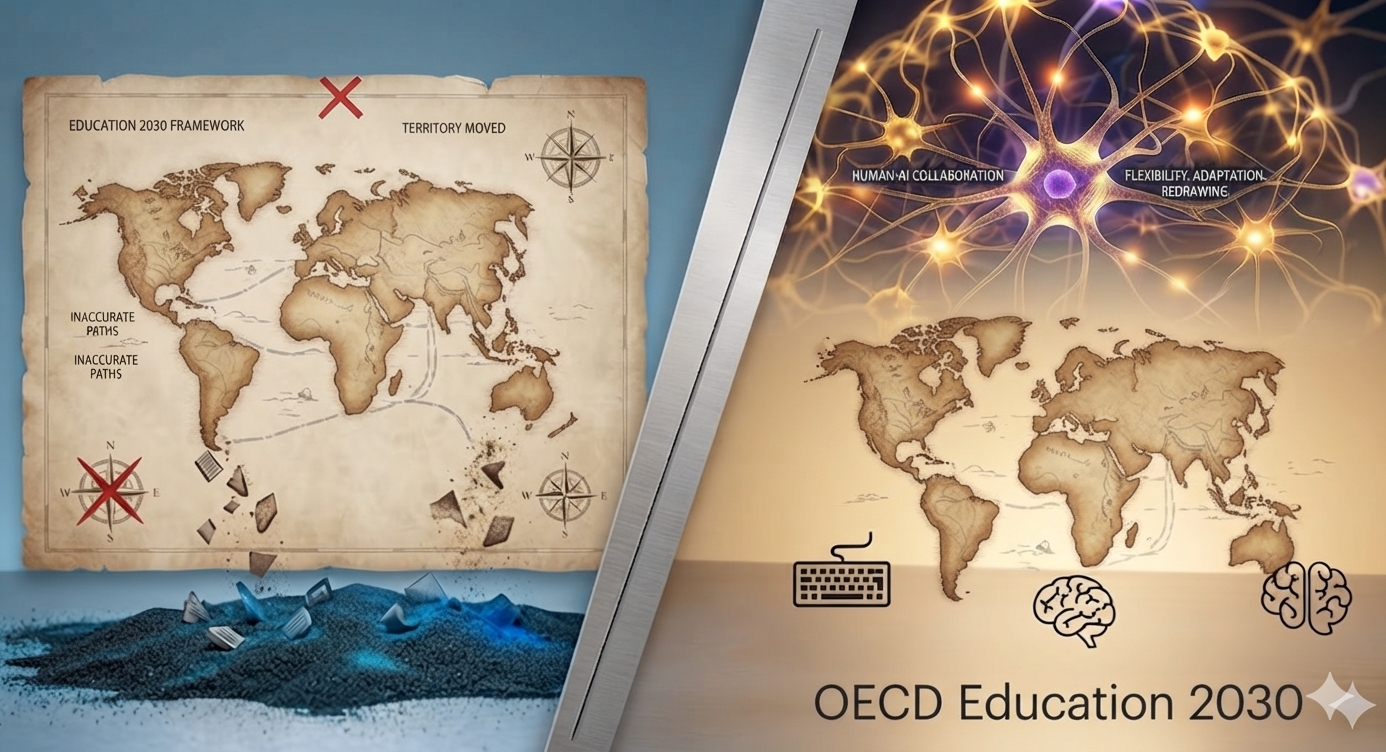
OECD Education 2030: The Map That Was Drawn Before the Territory Moved
Why the framework is now a historical document, not a compass
Picture a planning room in 2018. Whiteboards on every wall. Foresight consultants, ministry officials, curriculum designers from thirty countries. On the table: the question of what a child entering school today will need in order to thrive in 2030.
The people in that room were not naive. They were among the sharpest minds in education policy on the planet, and they were working with the best available evidence. They produced The Future of Education and Skills: Education 2030, a document that named student agency, transformative competencies, and lifelong learning as the pillars of the coming decade.
They got almost everything right.
And they missed the one thing that would rewrite every assumption in that room, because in 2018, it did not exist yet, and would not exist for another four years.
The Framework Wasn't Wrong. It Was Complete for a World That Ended.
This distinction is the whole argument, so let's be precise about it.
The usual critique of Education 2030 goes something like this: the framework is outdated and needs updating. That critique is comfortable, and it is wrong. Wrong in a way that will lead education systems to do exactly the wrong thing: bolt an "AI literacy" module onto a structure whose foundation has already slipped, and call it modernization.
Here is the reframe.
The OECD framework is not outdated. It is pre-Copernican.
It was written in a world where the human mind was assumed to be the only thinking thing in the room. Not stated as an assumption; assumptions are never stated. It was simply the water. Every competency the framework names, every learning outcome it describes, every assessment logic it implies, inherits that single unexamined premise.
The Pre-Generative Map
Think of a map of the Atlantic drawn in 1480.
It is not a bad map. The cartographer was skilled. The coastlines of Europe and Africa are rendered with care. The prevailing winds are marked. Everything on that map that could be known was known, and drawn well.
It is simply a map of a different world than the one that existed after 1492, and the difference is not a matter of detail. It is not that the map is missing a few islands. It is that the map's entire logic (what lies west, what the ocean is for, what a voyage means) was built on a premise that turned out to be false.
You can hang that map on a wall. You can admire the craftsmanship. You can learn a great deal from studying how its makers reasoned.
🔴 You cannot navigate by it.
Education 2030 is a Pre-Generative Map. And every education system currently using it as a strategic compass is sailing west with a chart that ends where the ocean was supposed to end.
What the Map Couldn't Show
Four premises quietly collapsed between 2018 and today. Not one of them was a footnote.
1. Cognition was assumed human-exclusive
Writing. Coding. Reasoning across complex information. Tutoring. Translation. Design. In 2018, these were the destination, the things education existed to build, because only humans could do them. They are now contested territory, performed at scale by systems that never sat in a classroom.
2. Knowledge acquisition was assumed teacher-mediated
The framework's model of learning runs through a human explainer. That channel is no longer the only one. A student now has access to a machine that explains, re-explains, adjusts to confusion, and never gets tired, at two in the morning, for free.
3. Assessment was assumed to measure the student
This one is the quiet catastrophe. Every assessment instrument in the framework assumes a clean boundary between what the learner knows and what the learner used. That boundary is gone. An essay now measures the student plus their tools, and the instrument cannot tell you which contributed what.
4. Work was assumed to drift
The framework plans for gradual evolution in the labor market, the pace of a decade. What is happening to cognitive occupations is not drift. It is folding, and it is happening on the timescale of quarters.
Not four gaps in the map. Four continents where the map showed open water.
The Questions That Weren't on the 2018 Whiteboard
Watch what happens when you take those collapsed premises seriously. A set of questions that were peripheral in 2018 (the kind of thing you might mention in a closing paragraph about "emerging technologies") move straight to the center of the field:
- Which cognitive processes should remain uniquely human? Not as a philosophical exercise. As a curriculum decision, with a budget and a timetable attached.
- Which capabilities should be deliberately delegated to machines, and which must be built the hard way, in the student's own skull, precisely because a machine could have done it for them?
- How does a student learn to collaborate with an intelligence that is faster, broader, and confidently wrong?
- How do you assess learning when the machine can pass your assessment?
- Which human competencies remain durable when machine intelligence is ubiquitous, free, and everywhere?
The Honest Defense
Now the part that intellectual honesty requires.
This is not a failure of analysis. The OECD did not reason poorly. Their evidence base was sound, their methodology was rigorous, their consultation was broad.
It is a failure of foreseeability, and foreseeability is not a moral category. You do not indict a 1480 cartographer for the absence of the Americas. He drew what could be seen.
✅ What survives intact
Agency. Ethics. Collaboration. Lifelong learning. These were the right principles. They remain the right principles. They were simply plotted on a map of the wrong world, and a right principle on a wrong map will still sail you into rocks.
Read Education 2030 for its principles. Do not navigate by its coastlines.
The Deeper Problem: Foresight Itself Is the Broken Object
Here is where the argument turns, and it turns against something larger than one document.
The real critique is not Education 2030. It is the genre it belongs to: the decade-horizon static framework. Convened over three years. Published as a fixed artifact. Cited for ten.
Look at what that genre actually is, structurally.
A framework with a ten-year shelf life is a bet that nothing will surprise you for ten years.
That is the wager. It's rarely stated, because stating it would make the terms visible, and the terms are absurd. For most of the twentieth century, education could afford that bet, because the world it planned for changed slowly enough to lose gracefully. That is no longer true. The bet is now unpayable, and every system still placing it is quietly accumulating a debt it will discover only when its graduates arrive in a labor market the strategy never imagined.
So the fix is not a better document. A better document, published in 2027 with a ten-year horizon, will be obsolete by 2029 and will have taught us nothing.
What a Post-Generative Model Has to Carry
If foresight becomes a metabolism rather than an artifact, four things have to be built into it structurally, not appended as a chapter.
1. Human–AI collaboration as a foundational competency
Not a digital-literacy elective. Foundational, in the same tier as reading. A student who cannot think with a machine, and, critically, who cannot think without one when it matters, is not literate in the environment they will actually inhabit.
2. Continuous adaptation as a design property
The system must be built to absorb a capability shift within a term, not a decade. This is an architecture requirement, not an attitude.
3. Cognitive systems thinking
The machine is not outside the learner's environment. It is in it: always available, always answering. Any model that treats AI as an external tool the student picks up and puts down is describing a world that no longer exists. It is part of the cognitive system now, and it must be modeled as such.
4. Dynamic curricula
Curricula that evolve alongside technological capability rather than freezing at the moment of publication. If the curriculum cannot move faster than the technology, the curriculum is not a plan. It is a fossil in progress.
💡 The Bottom Line
The OECD Education 2030 framework was a serious, careful, well-reasoned attempt to see forward from 2018. It succeeded on its own terms.
But it was drawn before the territory moved. Its principles endure; its map does not. Treating it as a current roadmap for education in the age of generative intelligence is not conservatism. It is navigation error, and it compounds.
It is a foundation. It is not a compass.
The unprecedented pace of what is happening means education can no longer plan by looking at a chart drawn years ago by people who could not have known. It has to plan the way a living system plans: by sensing, adapting, and redrawing, continuously, and without the comfort of a finished document.
The map on the wall is beautiful. Now put it down and look at the water.
Let's keep the conversation going 💬
I'd love to hear your take on this, whether you see things differently or if this aligns with your own experience. If you're reflecting on what to do now with these ideas or wondering how they might look in your specific situation, let's talk about it.
I'm always happy to trade thoughts or brainstorm how this applies to your world.
✉️ Drop me a note: [email protected]