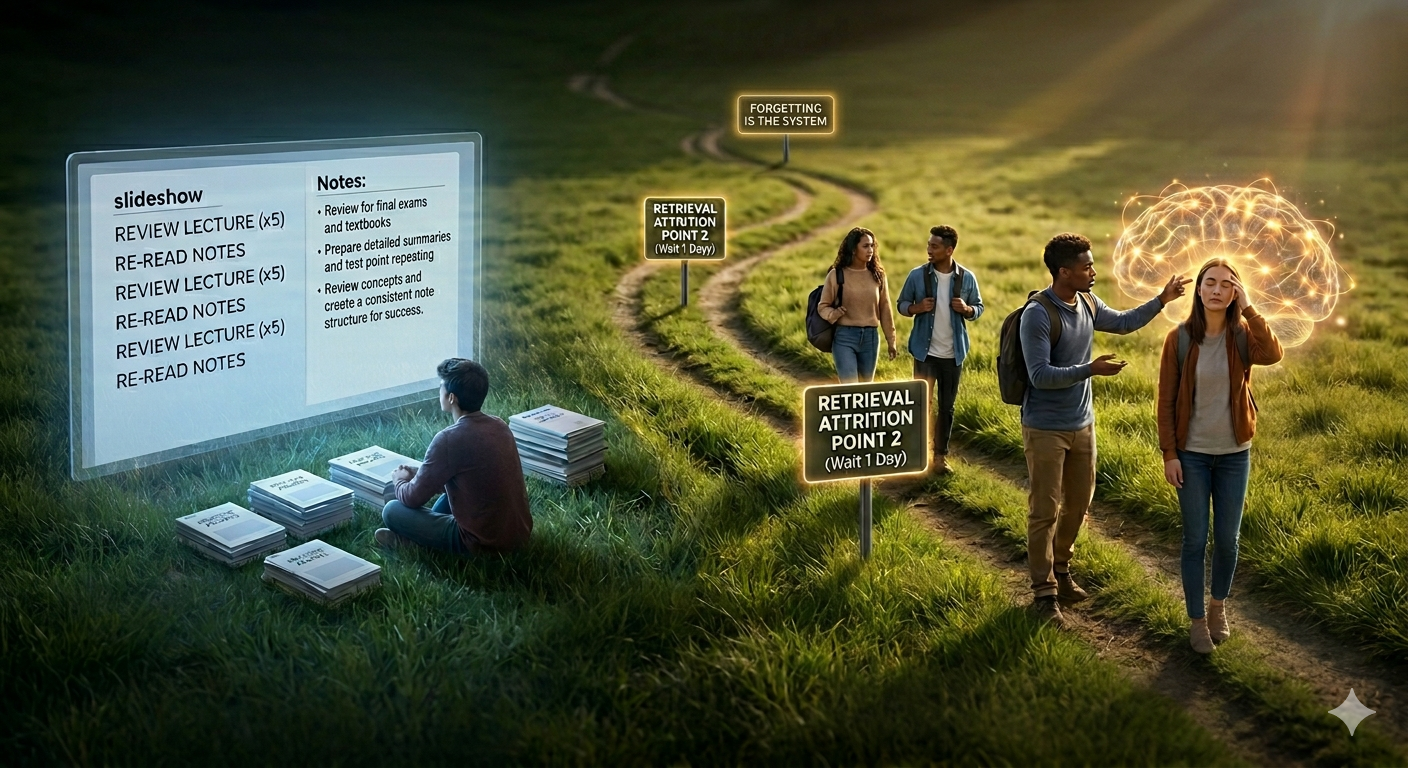
The Repetition Trap: Why Most "Review" Builds Nothing, and "Spaced Active Recall" Builds Memory
Article 5 in "The Biology of Education" series
Every year, schools and learning platforms pour enormous resources into one idea: repetition. Review sessions. Practice packets. Spaced-repetition apps. "Go over it again." It is the most universally endorsed principle in education, and almost nobody argues with it.
Which is exactly why it is dangerous.
Because the word "repetition" hides a fork in the road. Two teachers can both say "we repeat the material," run the same number of sessions, spend the same minutes — and produce completely different results. One builds memory that lasts a year. The other builds an illusion that collapses the morning of the exam.
This article is for the people who allocate that time and money — principals, district leaders, professional-development directors, anyone deciding how a school's review hours and software budgets get spent. The purpose is narrow and practical: to resolve a contradiction that confuses even careful educators, and to show that the two most powerful findings in the science of learning are not rivals. They are the same finding, seen from two angles.
The Contradiction That Isn't
Here are two statements. Both are repeated constantly by people who know the research. And on the surface, they appear to disagree.
The first: learning is repeated recall, not repeated exposure. Seeing information again does little; pulling it out of your own memory is what builds it.
The second: spaced repetition is one of the most effective study techniques we have. Spread your practice out over time and retention soars.
So which is it? If recall is what matters and mere repetition is weak, why do we celebrate "spaced repetition"? And if spacing is so powerful, doesn't that vindicate plain repetition after all?
The tension is an illusion. It comes entirely from the word "repetition" — a single word doing two completely different jobs.
Two Things Hiding in One Word
There are two kinds of repetition, and they are almost opposites.
- Repeated exposure: encountering the information again. Re-reading the notes. Re-watching the lecture. Looking at the vocabulary list one more time.
- Repeated retrieval: trying to pull the information out of memory without looking. Closing the notes and asking yourself what was on them. Answering the flashcard before flipping it.
These feel similar. They are not. And the reason they feel similar is itself part of the problem: re-reading produces a powerful sense of fluency. The words look familiar, the page feels easy, and the brain reads that ease as a signal — I know this. Researchers call it the illusion of competence, and it is one of the most reliable mistakes in human learning. Roediger and Karpicke found that the majority of students name re-reading as their main study strategy, while relatively few use self-testing — even though the evidence runs the other way.
⚠️ Retrieval is the opposite experience. It is effortful. It exposes what you don't yet know. It feels like worse studying. It is, in fact, far better studying.
The Evidence: Retrieval Beats Review
This is not a matter of opinion or teaching style. It is one of the most replicated results in cognitive psychology.
In the foundational study, Roediger and Karpicke had students read prose passages and then either take recall tests on the material or restudy it the same number of times, with no feedback. Then they measured retention at three delays. The result is the whole story in miniature: when the final test came after just five minutes, restudying produced better recall — but on the delayed tests, two days and a week later, prior testing produced substantially greater retention than restudying, even though restudying made students more confident they would remember.
Read that last clause again, because it is the trap in one sentence. The weaker method felt stronger. Exposure buys confidence; retrieval buys memory.
A later result sharpens the point even further. Once a piece of information can be recalled at all, what happens if you keep testing it versus keep studying it? Replicating Karpicke and Roediger's influential finding, Soderstrom, Kerr, and Bjork showed that once information can be recalled, repeated testing on that information enhances learning, whereas restudying it does not. Past the point of first encoding, re-exposure essentially stops contributing. Retrieval keeps building.
And when researchers step back and rank the full toolkit of study methods, the verdict is the same. In a comprehensive review of ten common learning techniques, Dunlosky and colleagues found that practice testing and distributed practice earned the highest utility ratings — benefiting learners of different ages and abilities across many subjects — while the techniques most students actually rely on, re-reading and highlighting, did not consistently improve performance. The two winners on that list are the two halves of our supposed contradiction.
So Where Does Spacing Come In?
Here is the resolution. Spacing is not a third thing competing with retrieval. Spacing is retrieval, scheduled. Put the two words together and you get the name for what actually works: Spaced Active Recall.
"Spaced repetition," properly understood, means repeated recall at carefully timed intervals. The spacing is not the magic by itself. The magic is the sequence it creates:
You begin to forget — slightly. Then you force a retrieval. The retrieval is effortful precisely because you've begun to forget. And that effort is what strengthens the memory. (That slight forgetting is not a flaw in the process but a necessary part of it — a point with a biology of its own, which a future article in this series on the forgetting curve will take up directly.)
Strip out the retrieval and spacing loses most of its power. Spreading out re-readings is still just re-reading; the gaps don't rescue a method that was weak to begin with. The spacing earns its reputation only because, done right, it forces the harder kind of repetition.
One Caveat
Exposure is not worthless — it is essential at the start. You cannot retrieve what you never encoded. The first encounter, the explanation, the worked example, the initial understanding: these come from exposure, and skipping them leaves nothing to recall later. The claim is not that exposure never matters. It is that after encoding, the quality of learning is dominated by the quality of retrieval. Exposure opens the door; Spaced Active Recall builds the house.
The research confirms the timing matters in a specific direction. Karpicke and Roediger found that expanding retrieval practice promotes short-term retention, but equally spaced retrieval produces better long-term retention. And the spacing effect itself is one of the best-documented phenomena in the field: a meta-analysis by Cepeda and colleagues drew on 839 assessments across 317 experiments, and found that the gap between study sessions and the length of time you need to remember the material operate together — the longer you need to retain something, the longer the ideal spacing between practice sessions.
In other words: forgetting a little, on purpose, is not a failure of the system. It is the system.
What the Brain Is Actually Doing
To see why the two ideas were never in conflict, it helps to drop the surface vocabulary and look at the mechanism underneath.
The most useful model comes from Robert and Elizabeth Bjork, who proposed that every memory has not one strength but two. Storage strength is how well-learned and deeply interconnected an item is — and it only ever increases. Retrieval strength is how accessible the item is right now — and it fluctuates with recency and context. The two come apart constantly. A fact can be deeply stored and yet, for the moment, hard to reach.
This distinction quietly explains everything above. When a memory has been partly forgotten, the learner has to work harder to recall it — and that recall effort is what produces a large gain in storage strength. The struggle is not a side effect of good studying. The struggle is the mechanism.
Now the roles snap into place. Retrieval is the act that grows storage strength. Spacing is the tool that guarantees the retrieval will be effortful — by allowing enough time for retrieval strength to fall before you reach for the memory again. Test something the instant after you read it and recall is easy, almost automatic, and it builds almost nothing. Wait until it has started to slip, then successfully reconstruct it, and you get the largest gain. The Bjorks call this family of conditions "desirable difficulties": obstacles that hurt performance in the moment but improve learning in the long run.
This is the hiking trail. Imagine a path worn through tall grass.
- Looking at the trail from a distance, over and over, does nothing to the trail — that is repeated exposure.
- Walking it again presses the path back down — that is retrieval.
- Letting the grass grow back a little before you walk it again forces you to rebuild the path, and the rebuilt path runs deeper than one merely re-walked while still fresh — that is Spaced Active Recall.
Each cycle of slight regrowth and effortful re-treading carves the route deeper than smooth, frequent walking ever could.
The trail is not strengthened by being seen. It is strengthened by being remade.
Questions to Ask Tomorrow
This isn't an abstract debate. It changes how a school spends some of its most limited resources — review time, quizzing tools, and the design of "practice." A few questions worth bringing into that conversation:
- When our classrooms "review," are students retrieving the material from memory, or re-encountering it on a slide? Which one are we actually scheduling?
- The spaced-repetition software we've bought or are considering — does it force an answer before revealing it, or does it just show cards on a timer? (Only the first is doing the work.)
- Are we treating low-stakes quizzing as assessment, or as a form of learning in its own right? The research says it is both.
- Do our students know that the harder, more effortful method is the better one — or are we letting the illusion of competence guide how they study?
- Where, in our calendar and our budget, are we paying for exposure when we believe we are paying for memory?
💡 Summary
"Repetition" hides two opposite mechanisms. Repeated exposure — re-reading, re-watching — feels productive and builds little durable memory. Repeated retrieval — pulling information out of your own head — feels harder and builds far more. Decades of replicated research, from Roediger and Karpicke through Dunlosky's review of the full toolkit, point the same way: testing yourself beats reviewing.
Spacing is not a competitor to this principle; it is its best delivery system. The two ideas combine into one: Spaced Active Recall. By letting a memory fade slightly before you reach for it again, spacing guarantees that each retrieval is effortful — and as the Bjorks' work shows, it is precisely that effortful, partly-forgotten retrieval that produces the largest gains in lasting memory.
The two "rival" ideas were always one idea. The trail is not strengthened by being seen. It is strengthened, again and again, by being remade.
Let's keep the conversation going 💬
The data here is unusually clear — but turning it into practice is where the real work begins. I'd love to hear your take, whether this matches what you're seeing in your own classrooms or cuts against it.
If you're thinking about how to shift your review time and tools from exposure toward genuine retrieval, let's talk it through.
✉️ Drop me a note: [email protected]Bibliography
Bjork, R. A., & Bjork, E. L. (1992). A new theory of disuse and an old theory of stimulus fluctuation. In A. Healy, S. Kosslyn, & R. Shiffrin (Eds.), From Learning Processes to Cognitive Processes: Essays in Honor of William K. Estes (Vol. 2, pp. 35–67). Erlbaum.
Cepeda, N. J., Pashler, H., Vul, E., Wixted, J. T., & Rohrer, D. (2006). Distributed practice in verbal recall tasks: A review and quantitative synthesis. Psychological Bulletin, 132(3), 354–380.
Dunlosky, J., Rawson, K. A., Marsh, E. J., Nathan, M. J., & Willingham, D. T. (2013). Improving students' learning with effective learning techniques: Promising directions from cognitive and educational psychology. Psychological Science in the Public Interest, 14(1), 4–58.
Karpicke, J. D., & Roediger, H. L. (2007). Expanding retrieval practice promotes short-term retention, but equally spaced retrieval enhances long-term retention. Journal of Experimental Psychology: Learning, Memory, and Cognition, 33(4), 704–719.
Roediger, H. L., & Karpicke, J. D. (2006). Test-enhanced learning: Taking memory tests improves long-term retention. Psychological Science, 17(3), 249–255.
Soderstrom, N. C., Kerr, T. K., & Bjork, R. A. (2016). The critical importance of retrieval — and spacing — for learning. Psychological Science, 27(2), 223–230.